



Medically reviewed by Jessica Churchill, MD | Reviewed July 2026
A shoulder labral tear vs. a rotator cuff tear is one of the comparisons I end up discussing more often than almost any other. Patients walk into my Denver clinic all the time already convinced they have a tear in the shoulder, without knowing which structure is actually involved. It is an understandable mix-up. A labral tear and a rotator cuff tear can produce overlapping symptoms, and both show up frequently enough in my practice that I spend a good part of many visits simply explaining the difference. They are not the same injury, they do not always respond to the same treatment, and mixing them up can send a treatment plan in the wrong direction.
Key Takeaways
- A labral tear involves the ring of cartilage that lines the shoulder socket, while a rotator cuff tear involves the muscles and tendons that move and stabilize the joint.
- Labral tears commonly cause catching, clicking, or a sense that the shoulder might slip out of place, while rotator cuff tears tend to cause weakness and aching pain with overhead motion.
- MRI, frequently performed with contrast dye for suspected labral injuries, usually gives the clearest answer when exam findings overlap.
Two Different Structures, Two Different Problems
The Labrum
Sorting out a shoulder labral tear vs. a rotator cuff tear starts with understanding that these are two entirely different structures doing two entirely different jobs. The labrum is a rim of fibrous cartilage that lines the shoulder socket, deepening it and helping the ball of the humerus stay centered during motion. It also serves as an anchor point for the biceps tendon and several key ligaments.
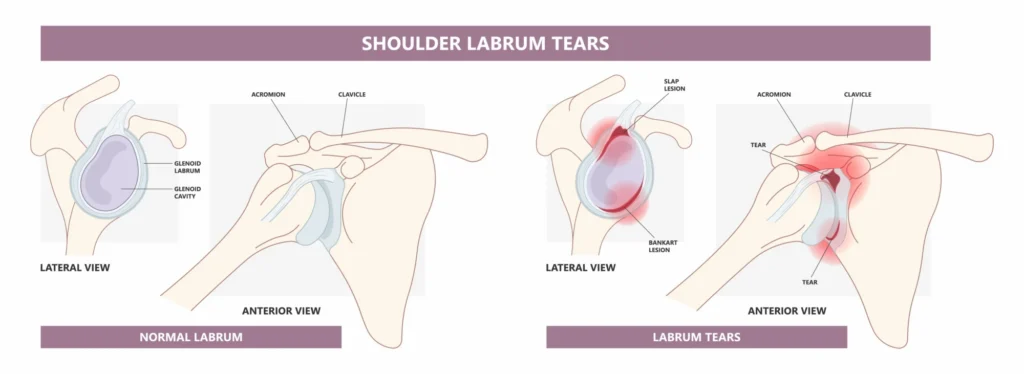
A tear here typically comes from a specific mechanism, like a fall onto an outstretched arm, a forceful pull during lifting, or repeated overhead motion in throwing athletes and weightlifters. Because the labrum plays such a large role in joint stability, tears often produce sensations that feel mechanical rather than simply painful, a catch during certain movements, a click that patients can sometimes reproduce on demand, or a vague feeling that the joint is not quite trustworthy.
The Rotator Cuff
The rotator cuff is a different structure entirely, a group of four muscles and their tendons that wrap around the head of the humerus and control both movement and fine positioning of the joint. A tear here can happen the same way a labral tear does, through trauma or repetitive strain, but the resulting symptoms usually lean toward weakness rather than instability.
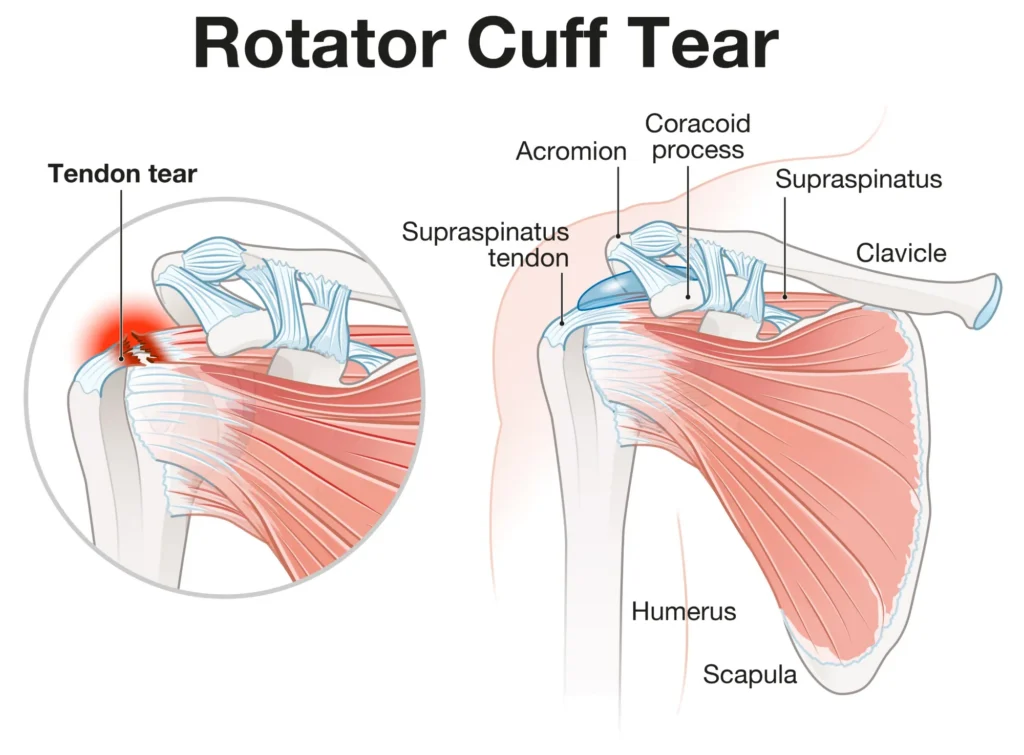
Reaching overhead becomes difficult not because the joint feels loose, but because the muscle responsible for lifting is no longer pulling its full weight. Night pain is also far more characteristic of rotator cuff involvement than labral tears, and patients frequently describe waking up when they roll onto the affected side.
Where the Two Overlap
The symptoms and causes overlap, which is why the two get confused. A significant rotator cuff tear can allow enough abnormal motion in the joint to create catching sensations that mimic a labral tear, and a labral tear near the biceps anchor can create pain patterns that mimic tendon irritation. This is where a careful physical exam earns its keep, testing strength in each rotator cuff muscle individually while also checking for signs of instability or a positive response to maneuvers that specifically stress the labrum.
Age and Activity as Clues
Age and activity history also shape which injury is more likely. Younger patients and overhead athletes tend to show up with labral tears, frequently tied to a specific throwing motion or a fall during a sport like skiing or mountain biking. Rotator cuff tears become more common with age, and by the time someone reaches their fifties or sixties, a cuff tear is statistically the more likely explanation for shoulder pain, even without a clear injury in the story. Neither pattern is a hard rule, and I have repaired labral tears in patients well into their sixties and rotator cuff tears in athletes in their twenties, but the general trend helps frame the conversation before imaging comes back.
What I See in My Patients
A Seasonal Pattern
Denver hands me a particular mix of these injuries throughout the year. Winter brings a wave of labral tears from falls on icy sidewalks and driveways, people reaching out instinctively to catch themselves and landing hard on an outstretched arm. Summer shifts the pattern toward rotator cuff complaints from mountain biking crashes, rock climbing at the nearby crags, and the kind of repetitive overhead work that comes with home renovation projects during the warmer months.
I also see plenty of rotator cuff tears that develop with no dramatic story attached at all, just years of wear finally catching up in someone who spent decades doing physical work or training in an overhead sport.
Listening to How Patients Describe It
What I have learned to listen for closely is the word patients use without prompting. Someone who says the shoulder gives out or slips is usually describing instability, which points me toward the labrum. Someone who says the arm just will not lift is usually describing weakness, which points me toward the cuff. Neither description is a diagnosis on its own, but it shapes how I approach the exam that follows.
Sudden Injury vs. Gradual Wear
I also notice how differently these two patient groups talk about timeline. The person with a labral tear from a specific fall can usually tell me exactly what they were doing and exactly when the shoulder started feeling wrong. The person with a rotator cuff tear from gradual wear often struggles to pin down when it started at all, describing months of slowly worsening stiffness before finally deciding the shoulder was not going to fix itself.
My Approach to Treatment
Exam and Imaging
My exam starts with a detailed history, including the exact mechanism of injury when there is one, followed by a hands-on assessment that tests both strength and stability. I look at each rotator cuff muscle separately, since a subscapularis tear behaves very differently from a supraspinatus tear, and I run the joint through positions designed to reproduce labral symptoms specifically. When findings are mixed, or when surgical planning depends on precise anatomy, I generally order an MRI, often with contrast, since a standard MRI can miss smaller labral tears that a contrast study picks up more reliably.
Matching Treatment to the Tear
Treatment decisions depend heavily on tear size and what the patient needs from the shoulder. Many partial rotator cuff tears and smaller labral tears respond well to a structured physical therapy program focused on strengthening the surrounding muscles and restoring normal joint mechanics. I tend to favor giving therapy a real chance before moving toward surgery, particularly for patients without significant instability or ongoing mechanical catching.
When a tear is large, when instability persists despite therapy, or when a patient’s goals genuinely require full strength and stability, such as returning to competitive overhead sport or physically demanding work, arthroscopic repair becomes a more central part of the conversation.
What Recovery Looks Like
Recovery paths differ too, and I try to set that expectation early rather than let a patient assume both injuries heal on the same schedule. Labral repairs generally involve a period of protecting the joint in a sling while the tissue reattaches, followed by a gradual return to overhead motion over a matter of months.
Rotator cuff repairs follow a similar early protection phase, but the timeline for regaining strength tends to run longer, since tendon healing to bone is a slower process than many patients expect. I would rather walk someone through that reality up front than have them measure their progress against a friend’s very different recovery.
Summary
A shoulder that catches is not the same problem as a shoulder that cannot lift, even though both can feel equally frustrating day to day. If you are still weighing shoulder labral tear vs. rotator cuff tear on your own, or honestly are not sure which one describes your shoulder, book a visit so we can sort out the condition properly rather than guessing based on symptoms alone.
Frequently Asked Questions
Can I have both a labral tear and a rotator cuff tear at the same time?
Yes, combined injuries happen, particularly after a significant fall or in shoulders with long-standing wear, and this is one reason a thorough exam and imaging matter.
Does a labral tear always require surgery?
No, many labral tears, especially smaller ones without severe instability, respond well to physical therapy focused on strengthening the muscles that support the joint.
Why does my shoulder click when I move it a certain way?
Clicking or catching often points toward a labral issue, though it can occasionally occur with rotator cuff tears as well, which is why an exam helps clarify the source.
Is a rotator cuff tear always caused by an injury?
Not always, many rotator cuff tears develop gradually from years of repetitive use or degeneration, particularly after age forty, without one specific incident.
How soon after a fall should I get my shoulder checked?
If pain, weakness, or a feeling of instability persists more than a few days after a fall, scheduling an evaluation sooner rather than later helps catch a tear before it worsens.