



Medically reviewed by Jessica Churchill, MD | Reviewed August 2026
Almost every patient who has shoulder surgery experiences some stiffness afterward. That part is expected, and I tell patients this before they ever go into the operating room. What catches people off guard is when shoulder stiffness after surgery lasts longer than they anticipated, or when it seems to be getting worse instead of better a few months out. In this post, I want to walk through what causes shoulder stiffness after surgery, how I tell the difference between normal healing and a problem worth addressing, and what I actually do about it in my Denver practice.
Key Takeaways
- A degree of shoulder stiffness after surgery is a normal, expected part of healing, particularly in the first several weeks while the shoulder is protected in a sling.
- Stiffness that persists or worsens beyond the expected window can come from scar tissue, inconsistent physical therapy, pain-related guarding, or an underlying tendency toward frozen shoulder.
- Consistent, guided physical therapy is the foundation of both preventing and treating post-surgical stiffness.
Why Some Stiffness After Surgery Is Normal
After procedures such as total shoulder replacement or reverse shoulder replacement, the arm is typically supported in a sling for a period of weeks to allow the repaired or replaced tissue to heal without being stressed too early. During that time, the shoulder is deliberately not moving through its full range, and the surrounding soft tissue, muscle, and joint capsule respond to that protected position by tightening somewhat. This is not a complication. It is a predictable consequence of the healing process itself, and it is one reason physical therapy is built into recovery from the very beginning rather than added later.
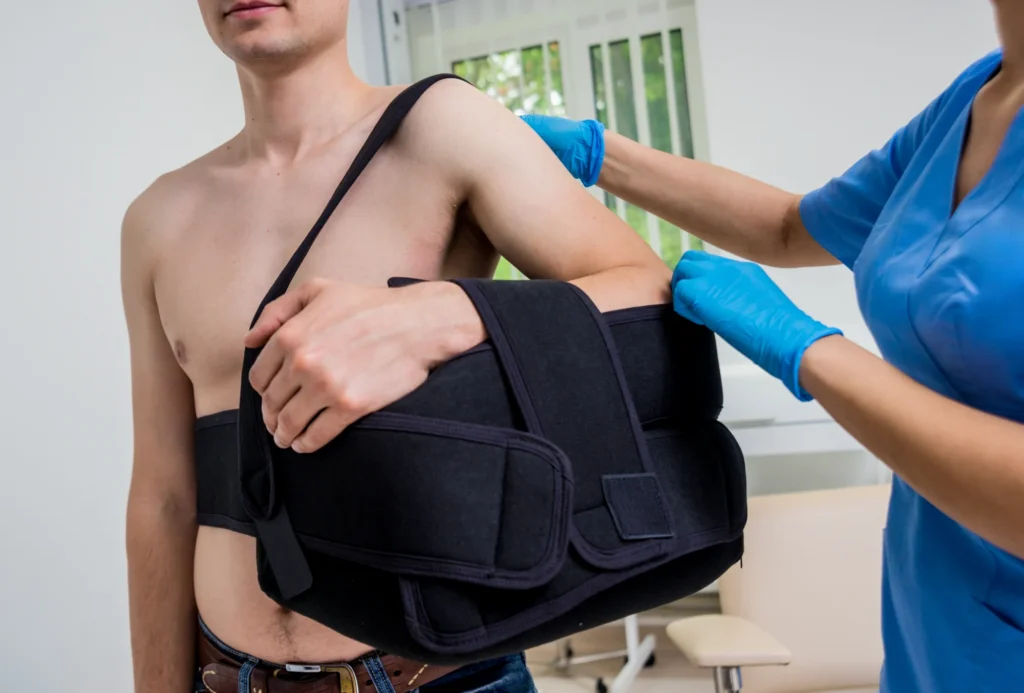
Motion after shoulder surgery is regained gradually, in phases, starting with passive movement guided by a therapist and progressing toward active motion and strengthening as healing allows. Some stiffness in the early phases is simply part of that timeline, not a sign that something has gone wrong.
What a Typical Recovery Timeline Looks Like
In the first few weeks after total or reverse shoulder replacement, the sling stays on for most of the day, and therapy focuses on gentle, passive range-of-motion exercises, meaning the therapist or the patient’s other arm moves the joint rather than the surgical shoulder’s own muscles doing the work. This phase can feel discouragingly slow, but it protects the healing tissue while still preventing the capsule from tightening excessively.
As healing progresses, usually somewhere around the six-week mark though this varies by procedure and by patient, active motion is introduced, meaning the patient begins moving the arm under their own power within a safe range. Strengthening comes later still, once the surgical repair has matured enough to tolerate resistance. Stiffness that shows up during the early passive phase and improves as therapy advances through these stages is following the expected pattern. Stiffness that fails to improve as a patient moves into the active and strengthening phases is what prompts a closer look.
What Causes Shoulder Stiffness After Surgery Beyond the Expected Window?
When stiffness lingers well past the point where I would expect meaningful improvement, or when it progresses instead of easing, a handful of specific causes may explain what is happening.
Scar Tissue and Capsule Tightening
The same joint capsule involved in frozen shoulder can also tighten after surgery, sometimes independent of the original procedure entirely. Surgical healing naturally involves scar tissue formation, and in some patients that scar tissue becomes more extensive or more restrictive than expected, limiting how far the joint can move even after the underlying repair has healed well.
Delayed or Inconsistent Physical Therapy
Gaps in physical therapy attendance or inconsistent follow-through at home tend to show up directly in a patient’s range of motion at follow-up visits. A missed few weeks of therapy early in recovery, whether from scheduling difficulty, insurance issues, or simply feeling too sore to push through the exercises, can allow stiffness to set in more than it would have with steady, guided progress.
Pain-Related Guarding
Pain and stiffness feed each other. When motion is uncomfortable, it is natural to unconsciously protect the shoulder by limiting how far you move it, and that protective guarding, sustained over weeks, can itself contribute to tightening of the surrounding tissue. Addressing pain adequately during the early recovery period is not just about comfort. It directly supports a patient’s ability to participate fully in the range-of-motion work that prevents stiffness from becoming entrenched.
An Underlying Tendency Toward Frozen Shoulder
Some patients carry the same risk factors that contribute to frozen shoulder more broadly, including diabetes and thyroid disease, and surgery itself can act as the triggering event for that process in a susceptible shoulder. When I see a postoperative shoulder that is stiffer than the procedure and timeline alone would explain, this is one of the first possibilities I consider, particularly in patients with a relevant medical history.
What I See in My Patients Here in Denver
In my Denver Health practice, I notice stiffness concerns cluster around two groups in particular. The first is patients who find it genuinely difficult to get to therapy sessions as often as recommended during Colorado winters, when road conditions and weather can turn a short drive into a real obstacle. The second is highly motivated, active patients who, somewhat counterintuitively, sometimes struggle with pacing. They either push too hard too early and provoke pain that leads to guarding, or they become so cautious after a painful setback that they under-move for weeks afterward.
My honest opinion, after years of watching recoveries play out, is that consistency matters more than intensity. A patient who does their prescribed exercises every day at a moderate, tolerable level tends to outperform a patient who does aggressive sessions inconsistently, even if the aggressive sessions look more impressive on paper.
I also think Denver’s active culture cuts both ways here. Patients are frequently eager to get back to hiking, skiing, or their gym routine, and that motivation is genuinely helpful for engagement with therapy. The flip side is that some patients try to test their shoulder against an activity before their surgical timeline supports it, provoke pain, and then overcorrect by avoiding motion altogether for the following weeks.
How I Approach Post-Surgical Stiffness
My approach depends on where a patient is in their recovery timeline and how far their motion has fallen behind what I would expect at that point.
Reinforcing the Rehabilitation Plan
For many patients, the first step is simply getting therapy back on track, whether that means addressing barriers to attendance, adjusting the home exercise program, or working more closely with the physical therapist on technique.
Preventing Stiffness Before It Starts
Prevention is easier to influence than treatment, which is why I spend time on it before a patient ever has surgery. This includes setting clear expectations about the sling period, scheduling therapy referrals early so there is no gap between surgery and the first session, and discussing pain management proactively rather than waiting for a patient to fall behind on exercises because discomfort caught them off guard.
Managing Pain So Patients Can Participate Fully
If pain is limiting a patient’s ability to engage in therapy, I look at adjusting the pain management plan so that rehabilitation becomes more tolerable, rather than accepting reduced participation as inevitable. This might involve medication adjustments or timing therapy sessions around when pain is best controlled.
Additional Intervention for Persistent Cases
For shoulders that remain significantly restricted despite a genuine, sustained effort at rehabilitation, I discuss the same kinds of interventions used for frozen shoulder more broadly, including corticosteroid injections and, in select persistent cases, manipulation under anesthesia or arthroscopic capsular release. I do not reach for these tools quickly. They come into the conversation when a patient has given consistent therapy a real chance and motion still is not progressing the way it should.
Summary
Shoulder stiffness after surgery is expected in the early recovery period, and it usually resolves with consistent, guided rehabilitation. When it persists or worsens, the explanation is often scar tissue formation, gaps in therapy, pain-related guarding, or an underlying susceptibility to frozen shoulder that surgery has triggered. Identifying which of these applies to you is the first step toward getting your recovery back on track.
If your shoulder feels stiffer than it should at this point in your recovery, or you had surgery months ago in the Denver area and still cannot move the way you expected to by now, I would encourage you to come in for an evaluation rather than assuming it will simply resolve on its own. You can request an appointment online or call our office at (303) 436-4949, and we will assess exactly where your recovery stands and what steps make sense from here.
Frequently Asked Questions
How much shoulder stiffness after surgery is considered normal?
Some stiffness is expected for the first several weeks to a few months after shoulder surgery, particularly while the arm is protected in a sling and early healing is taking place. What matters most is the trajectory. Motion should be gradually improving with therapy rather than staying flat or worsening over successive follow-up visits.
When should I be concerned that my shoulder is too stiff after surgery?
If your range of motion has plateaued for several weeks despite consistent physical therapy, or if stiffness is worsening rather than improving, it is worth being evaluated. This does not necessarily mean something has gone wrong with the surgery itself, but it does mean the recovery plan may need adjustment.
Can I do anything at home to reduce stiffness after shoulder surgery?
Consistency with your prescribed home exercise program is the most important thing most patients can control. Beyond that, managing pain adequately so that you can participate fully in therapy, and attending scheduled sessions even when progress feels slow, both support better outcomes. Always follow the specific guidance your surgeon and therapist give you rather than a generic routine, since the right exercises depend on your procedure and healing stage.
Does stiffness after surgery mean the surgery failed?
No, and I want to be direct about that. Stiffness is a common part of the recovery process and does not necessarily reflect a problem with how the surgery itself went. Most cases of post-surgical stiffness respond well to continued, guided rehabilitation, and only a smaller subset require additional intervention beyond therapy.