


Medically reviewed by Jessica Churchill, MD | Reviewed May 2026
Many patients ask me, “What is a labral tear?” along with whether it can heal on its own and if surgery is always necessary. In this post, I’ll walk you through what the labrum is, how these tears are diagnosed, and how I approach treatment decisions with my patients here in Denver. My goal is to give you a clearer understanding of what’s happening in your shoulder and what your realistic options look like moving forward.
Key Takeaways
- The labrum is a ring of cartilage that deepens the shoulder socket and helps keep the joint stable.
- Labral tears can develop from a sudden injury (like a dislocation) or from repetitive overhead stress over time, and they are particularly common in throwing athletes.
- Not every labral tear requires surgery, and many patients do well with a conservative approach.
- For tears that cause ongoing instability or pain that does not improve, arthroscopic surgery to repair or remove the damaged tissue may be recommended.
What Is the Labrum?
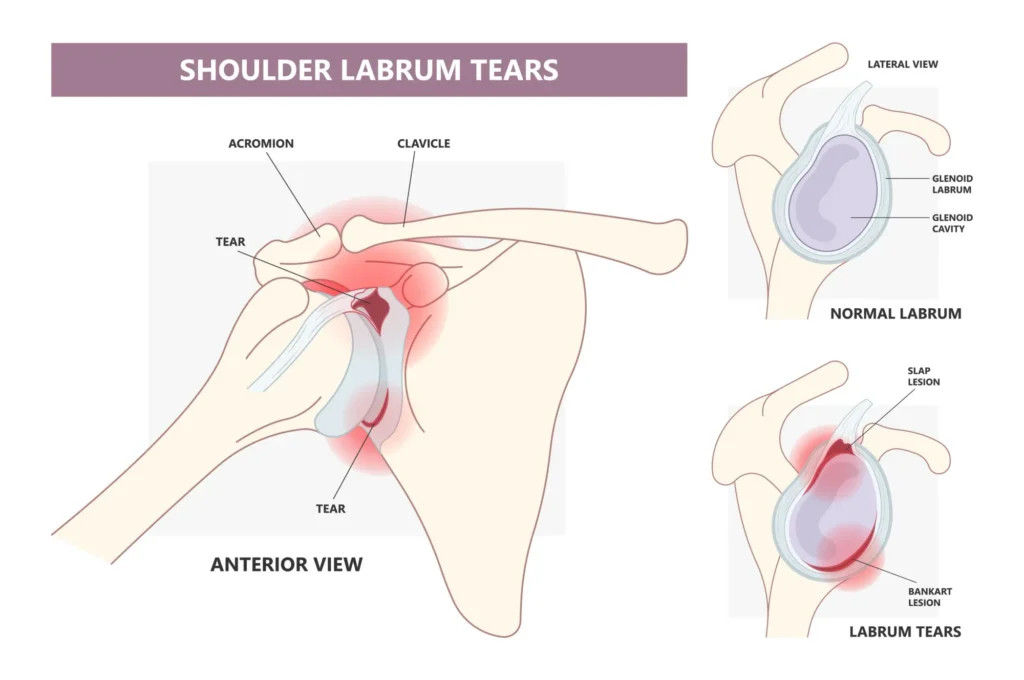
The shoulder is a ball-and-socket joint, but here is the thing: the socket is quite shallow on its own. Without some extra structure, that ball could move around far more than it should. The labrum solves that problem. It is a ring of firm, rubbery cartilage that lines the rim of the socket (the glenoid) and essentially deepens it, giving the ball of the upper arm bone (the humerus) a more secure place to sit.
The labrum also serves as an anchor point for several important ligaments and the long head of the biceps tendon. This means it plays a central role not just in cushioning, but in holding the joint together during movement. When it tears, the shoulder can lose some of that stability.
How Does a Labral Tear Happen?
Labral tears tend to fall into two broad categories: those that happen suddenly and those that develop gradually over time.
Acute tears commonly occur after a traumatic event. A shoulder dislocation is one of the most common culprits. When the ball of the shoulder is forced out of the socket, it can peel or tear the labrum away from the bone. A fall on an outstretched arm, a direct blow to the shoulder, or a forceful pulling injury can also cause an acute labral tear.
Gradual, or degenerative, tears tend to build up from repetitive stress. Overhead athletes (including baseball pitchers, swimmers, tennis players, and volleyball players) place repetitive strain on the shoulder with every throw, stroke, or swing. Over time, this can wear down the labral tissue. Weightlifters and people whose work involves frequent overhead reaching may also develop labral tears through this kind of chronic loading.
There is also a specific type of labral tear called a SLAP tear, which stands for Superior Labrum Anterior to Posterior. This involves the top portion of the labrum where the biceps tendon attaches. SLAP tears are especially common in overhead-throwing athletes and can cause a deep, hard-to-pinpoint pain in the shoulder, along with a popping or clicking sensation during certain movements.
What Does a Labral Tear Feel Like?
Symptoms can vary quite a bit depending on where the tear is, how significant it is, and whether any other structures in the shoulder are involved. That said, there are some patterns I see regularly.
Pain is usually the first thing patients notice. It tends to feel deep within the shoulder. The discomfort may be worse with overhead activities, throwing, or carrying objects away from the body. Some patients also describe an ache at night, especially when sleeping on the affected side.
Beyond pain, many people notice a mechanical sensation in the shoulder. A catching, clicking, or grinding feeling during arm movement can be a sign that a piece of torn labral tissue is getting caught in the joint. This sensation can be unsettling, and it often prompts patients to come in for an evaluation.
Instability is another common symptom, particularly in cases where a dislocation or subluxation (partial dislocation) led to the tear. The shoulder may feel like it wants to slip or give way, especially when the arm is raised and rotated outward. Some patients describe it as a “dead arm” feeling after certain movements.
Weakness may also develop over time, particularly with overhead lifting or rotation. Because the labrum connects to several key structures in the shoulder, a tear can affect the efficiency of the whole joint.
How Is a Labral Tear Diagnosed?
Getting an accurate diagnosis is an important first step, and it typically begins with a thorough physical examination. I will ask about your symptoms, when they started, what makes them better or worse, and your history of shoulder injuries or surgeries. I’ll then perform a series of specific tests to assess stability, range of motion, and pinpoint the source of discomfort.
Physical exam findings can be very telling, but imaging is usually needed to confirm the diagnosis and understand the extent of the injury. A standard MRI can reveal a lot about the soft tissues in the shoulder, but for labral tears specifically, an MRI arthrogram (where contrast dye is injected into the joint) may provide more detail. X-rays may be ordered as well. While they do not show the labrum directly, they can help rule out other causes of shoulder pain, such as fractures, arthritis, or bone spurs that might be contributing to symptoms.
Does Every Labral Tear Need Surgery?
Not every labral tear requires surgery. When a patient comes to me with a labral tear, my first question is always: how much is this affecting your daily life and your goals? The decision depends on several factors, including the type and location of the tear, the degree of instability, and what you want to get back to.
When Conservative Treatment May Be Enough
For many patients, especially those with partial tears or tears that are not causing significant instability, a non-surgical approach can be very effective. Physical therapy is typically the first line of treatment. The goal is to strengthen the muscles around the shoulder, particularly the rotator cuff, so that they can compensate for any reduced stability from the labrum. This kind of targeted rehabilitation can go a long way toward reducing pain and improving function.
Activity modification also plays a role during the early stages of recovery. Temporarily dialing back the activities that provoke symptoms, particularly overhead throwing or heavy lifting, gives the shoulder a chance to calm down while therapy builds up the surrounding support.
Anti-inflammatory medications may be recommended to help manage pain and swelling. In some cases, a corticosteroid injection into the joint can provide meaningful short-term relief and allow patients to engage more fully in physical therapy.
When Surgery Tends to Become the Conversation
Surgery is more likely to come up when the labral tear has led to severe shoulder instability, when conservative treatment has not produced adequate improvement after a reasonable period of time, or when the tear is large and carries a high risk of re-injury without repair.
Younger, active patients, particularly those who want to return to overhead or contact sports, may also benefit from surgical repair. Research tends to suggest that in this group, the risk of recurrent dislocation is higher without surgical stabilization, and early repair may produce better long-term outcomes.
When surgery is recommended, the most common approach is arthroscopic repair. During this procedure, I make a few small incisions around the shoulder and use a tiny camera to see inside the joint. Specialized instruments allow me to reattach the torn labrum to the bone and address any associated injuries, all without the need for a large open incision.
Summary
A labral tear can be a source of real pain and frustration, but it does not automatically mean surgery is in your future. Understanding what the labrum does, how tears occur, and what your options are can help you feel more in control of your care. If you are experiencing deep shoulder pain, a clicking or catching sensation, or a sense that your shoulder is not quite stable, it may be worth getting an evaluation. As a shoulder specialist in Denver, I take the time to understand each patient’s specific situation and goals before discussing treatment recommendations. Whether we are talking about a focused rehab plan or considering a surgical option, the right path is always one we decide on together. If you are dealing with persistent shoulder pain, I encourage you to request an appointment.
Frequently Asked Questions
Can a labral tear heal on its own without treatment?
The labrum has limited blood supply, which means it does not tend to heal as readily as some other tissues in the body. Minor tears may become less symptomatic over time with rest and activity modification, but the structural damage typically remains.
Is it safe to keep exercising with a labral tear?
It depends on the severity of the tear and what types of activity are involved. Many patients can continue with low-impact exercise and general fitness with some modifications. However, activities that repeatedly load the shoulder in unstable positions, particularly overhead throwing, heavy pressing movements, or contact sports, may need to be temporarily avoided. I can help you figure out what is safe and appropriate for your specific situation.
What is the difference between a SLAP tear and other labral tears?
A SLAP tear refers specifically to a tear at the top of the labrum (the superior labrum) that extends from front to back, at the point where the biceps tendon attaches. Other labral tears can occur at various positions around the labrum. The type and location of the tear helps guide treatment decisions.
Can I return to overhead sports after labral repair surgery?
Many patients do return to overhead sports after labral repair, though the timeline and outcome can vary depending on the severity of the tear, the type of repair performed, and how diligently a patient engages with rehabilitation. In younger overhead athletes, return-to-sport rates following arthroscopic repair are generally favorable. That said, I am always honest with my patients about the realistic expectations for their specific case, and we discuss goals together as part of the treatment planning process.