



Medically reviewed by Jessica Churchill, MD | Reviewed May 2026
If you’ve been struggling with a stiff, painful shoulder that seems to be getting worse no matter what you do, you may be dealing with frozen shoulder. It’s a condition I see often in my practice here in Denver. Understanding what frozen shoulder is, why it happens, and what your treatment path might look like can make a difference in how you approach recovery. In this post, I’ll walk you through the stages of frozen shoulder, the risk factors that tend to come up, and the range of treatment options available, from conservative care to procedures we might explore together in the clinic.
Key Takeaways
- Frozen shoulder, also called adhesive capsulitis, occurs when the connective tissue surrounding the shoulder joint tightens and thickens, causing pain and a loss of motion.
- The condition tends to move through three stages (freezing, frozen, and thawing) which can span months to years.
- Treatment options range from physical therapy and anti-inflammatory medications to corticosteroid injections and, in some cases, surgical intervention.
What Is Frozen Shoulder?
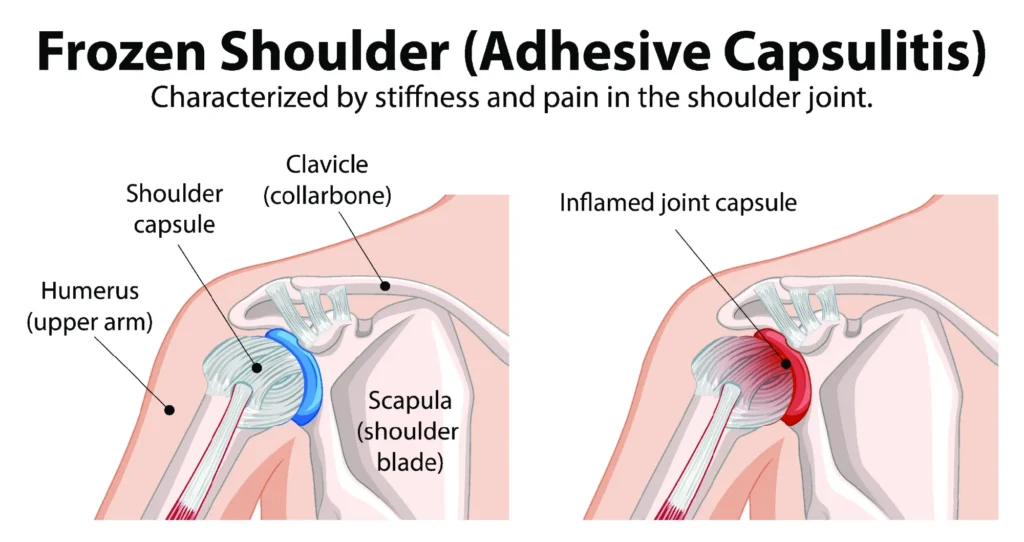
Frozen shoulder, or adhesive capsulitis, as we call it clinically, is a condition where the capsule of connective tissue surrounding the shoulder joint becomes thickened, inflamed, and tight. As this tissue tightens, it restricts the joint from all directions, making it increasingly painful and difficult to move your arm. Over time, scar tissue can form and bands of tissue called adhesions may develop, further limiting motion. It typically affects the glenohumeral joint, which is the main ball-and-socket joint in the shoulder.
What makes frozen shoulder particularly difficult to manage is the slow pace at which it develops and resolves. It doesn’t usually show up overnight. And it doesn’t leave quickly either.
The Three Stages of Frozen Shoulder
Frozen shoulder tends to follow a fairly predictable progression, moving through three distinct phases. Not everyone moves through them at the same speed, but recognizing where you are in the process can help guide treatment decisions.
Stage 1: Freezing
The freezing stage is often when people first notice that something is wrong. The shoulder begins to ache, usually with a gradual onset rather than a sudden injury. Pain may be worse at night, and you might find yourself unconsciously guarding the shoulder.
Stage 2: Frozen
During the frozen stage, the pain may actually ease slightly, but the stiffness tends to worsen. This is when range of motion can become limited. Simple tasks like reaching into a back pocket, fastening a seatbelt, or lifting your arm overhead may become genuinely difficult.
Stage 3: Thawing
The thawing stage is when things gradually start to improve. Motion slowly returns, and discomfort tends to decrease. This phase can take months or even longer, depending on the individual. Many individuals do regain meaningful shoulder function over time.
Understanding where you are in these stages can help shape the approach we take to your care. The options that make the most sense in the freezing stage may look quite different from those in the frozen or thawing phase.
Who Is at Risk?
Frozen shoulder doesn’t choose randomly. Certain factors seem to increase the likelihood of developing it.
Immobility after injury or surgery. One of the most common triggers is prolonged immobility. If the shoulder is kept still for an extended period, such as following a rotator cuff injury, a fracture, or surgery, the capsule can begin to tighten. This is part of why movement and rehabilitation after shoulder injuries are so important.
Diabetes. People with diabetes, particularly those with poorly controlled blood sugar, are more likely to develop frozen shoulder.
Thyroid disorders. Both hypothyroidism and hyperthyroidism have been associated with a higher risk of frozen shoulder. If you have a thyroid condition and start noticing shoulder stiffness, it’s worth paying attention to early on.
Age and sex. Frozen shoulder most commonly affects people between the ages of 40 and 60, and it tends to occur more frequently in women than in men.
Other contributing factors. Certain conditions involving the cardiovascular system, nervous system, or autoimmune function may also play a role in some cases.
None of these factors guarantees that you’ll develop frozen shoulder. However, they can help your care team understand your risk and monitor for early signs.
How Is Frozen Shoulder Diagnosed?
There’s no single definitive test for frozen shoulder. Diagnosis typically relies on a review of your symptoms, a physical examination, and sometimes imaging. During the exam, I’ll assess both active range of motion, meaning how far you can move your arm on your own, and passive range of motion, meaning how far I can move it for you. In frozen shoulder, both are typically reduced, which can help distinguish it from some other shoulder conditions.
X-rays can be useful to rule out other causes of shoulder pain, such as arthritis or a fracture. In some cases, an MRI may be ordered to evaluate the soft tissues and provide a clearer picture of the joint capsule and surrounding structures.
If you’ve been dealing with shoulder stiffness and you’re not sure what’s going on, coming in for an evaluation is a good first step. Getting an accurate diagnosis makes it much easier to map out the right path forward.
Treatment Options for Frozen Shoulder
One of the most common questions I hear in the clinic is: What can actually be done about this? My approach depends a lot on where you are in the condition’s course, how much your function is affected, and what your personal goals are. Early in the freezing stage, I tend to focus on controlling pain and protecting the shoulder. As things stabilize, we shift toward more active rehabilitation.
Physical Therapy
Physical therapy is frequently a component of frozen shoulder treatment, particularly in the early and middle stages. A skilled physical therapist can guide you through stretching and range-of-motion exercises designed to gently mobilize the joint and work against the tightening capsule.
Anti-Inflammatory Medications
Nonsteroidal anti-inflammatory drugs, or NSAIDs, may help manage the pain and inflammation associated with frozen shoulder, particularly during the freezing and early frozen stages. Medications alone aren’t likely to resolve frozen shoulder, but they can make it more manageable while other treatments do their work.
Corticosteroid Injections
Corticosteroid injections may offer meaningful pain relief in some cases of frozen shoulder. The injection delivers a powerful anti-inflammatory medication directly into the joint, which may help reduce swelling in the capsule and make physical therapy more tolerable. For some patients, injections provide enough relief that they can engage more fully in rehabilitation.
Hydrodilatation
Hydrodilatation is a procedure in which sterile fluid is injected into the joint under imaging guidance. The goal is to stretch the joint capsule and help break up some of the tightness. It’s not appropriate for every patient, but in selected cases, it can be a useful tool for improving range of motion and easing pain.
Manipulation Under Anesthesia
In cases where conservative treatments haven’t provided adequate improvement, manipulation under anesthesia may be considered. During this procedure, you are placed under general anesthesia so the shoulder can be gently moved through its range of motion without the protective guarding that pain typically causes. This can help break up adhesions and restore mobility.
Shoulder Arthroscopy
For more persistent or severe cases of frozen shoulder, arthroscopic surgery may be an option. During this minimally invasive procedure, small incisions allow a camera and surgical instruments to be introduced into the shoulder joint. The surgeon can release the tight portions of the capsule directly, a procedure called an arthroscopic capsular release.
Summary
Frozen shoulder is a challenging condition, but it is manageable. The key is understanding where you are in the process and working with someone who can match the treatment approach to your specific stage and goals. From physical therapy and medications to injections and, when appropriate, surgical options, there is a meaningful range of choices available.
If you’re in the Denver area and shoulder stiffness or pain has been getting in the way of your daily life, I’d encourage you to come in for an evaluation. You can request an appointment online or give our office a call at (303) 436-4949. Let’s figure out what’s going on and build a plan that makes sense for you.
Frequently Asked Questions
How long does frozen shoulder typically last?
The full course of frozen shoulder, from onset through recovery, can range from one to three years in many cases, though this varies considerably from person to person. Some patients improve more quickly, particularly with consistent treatment. Others may take longer, especially if the condition went unrecognized for a period of time.
Can frozen shoulder resolve on its own without treatment?
In some cases, frozen shoulder does eventually improve without formal treatment, but this can take a long time and doesn’t always result in a full return of motion. Treatment, particularly physical therapy, is generally recommended because it may speed up recovery, reduce pain during the process, and improve the degree of motion regained.
Are there any activities I should completely avoid?
Not necessarily. In most cases, you don’t need to stop moving entirely. In fact, keeping the shoulder gently active tends to be beneficial. That said, high-impact activities, heavy overhead lifting, or exercises that cause significant pain are best avoided during active flares. I will provide specific guidance based on your current level of function and where you are in the course of the condition.
Can frozen shoulder affect both shoulders?
It can, though developing it in both shoulders at the same time is relatively uncommon. More often, if frozen shoulder does affect both sides, it tends to develop in one shoulder first and then the other over time. People with diabetes appear to have a somewhat higher likelihood of bilateral involvement. If you are noticing stiffness on both sides, that is worth mentioning during your evaluation.