



Medically reviewed by Jessica Churchill, MD | Reviewed May 2026
If you have been dealing with a nagging ache every time you reach for something overhead, or pain that flares up when you lift your arm to the side, shoulder impingement may be the cause. In my practice as a shoulder and elbow surgeon here in Denver, shoulder impingement syndrome is one of the more common diagnoses I see. In this post, I want to walk you through what shoulder impingement actually is, why it happens, what the symptoms look like, and how we typically approach treatment.
Key Takeaways
- Shoulder impingement syndrome occurs when the tendons or bursae in the shoulder become compressed during arm movement, leading to irritation and pain.
- The most common symptoms include pain when lifting the arm, especially overhead, along with aching at rest and weakness with certain activities.
- Many cases can be managed without surgery through physical therapy, activity modification, and anti-inflammatory treatments.
- When conservative care does not provide sufficient relief, minimally invasive procedures may be considered to reduce pressure on the affected soft tissues.
What Is Shoulder Impingement Syndrome?
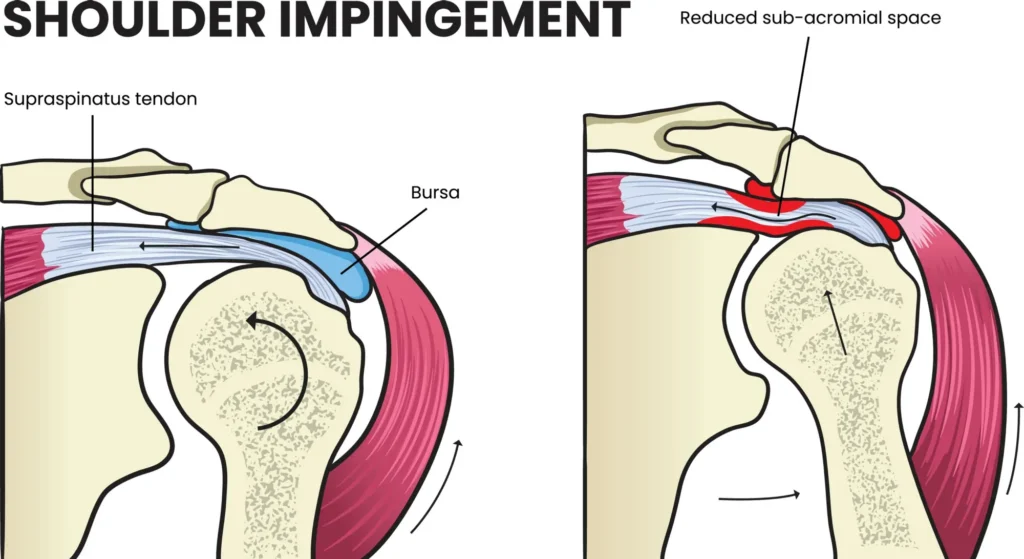
Shoulder impingement syndrome, sometimes called subacromial impingement, happens when soft tissue structures in the shoulder get pinched or compressed as the arm moves. Specifically, the tendons of the rotator cuff and a small, fluid-filled cushion called the subacromial bursa sit in a narrow space between the top of the humerus (your upper arm bone) and the acromion, which is a bony shelf that forms the roof of the shoulder. When you lift your arm, that space may get a little tighter. If there is not enough room, or if the tissues are already inflamed, compression occurs. Over time, repeated irritation can lead to inflammation, swelling, and in some cases, damage to the rotator cuff tendons themselves.
What Causes Shoulder Impingement?
Shoulder impingement tends to develop from a combination of factors rather than one single cause. Repetitive overhead activity is a well-known risk factor. Athletes who perform a lot of throwing, swimming, or tennis, as well as workers who frequently reach above shoulder height, may place repeated stress on the subacromial space. Over time, this may cause the bursa and tendons to become irritated and thickened, which further reduces the available space.
Poor posture and muscle imbalances can also play a role. When the muscles that help stabilize and position the shoulder blade are weak or tight, the mechanics of arm movement may become inefficient. This may cause the humeral head to shift slightly upward during lifting, compressing the soft tissues beneath the acromion.
Structural factors can contribute as well. Some people naturally have a more curved or hook-shaped acromion, which may leave less room for the tendons and bursa to pass through. Age-related changes, such as the development of bone spurs along the acromion, can also narrow the subacromial space and increase the likelihood of impingement.
Previous shoulder injuries, inflammation from conditions like bursitis, and even the natural thickening of the rotator cuff tendons that can come with age may all increase the risk of developing this condition.
Recognizing the Symptoms of Shoulder Impingement
Shoulder impingement can feel different from person to person, but there are several patterns I commonly see in my patients. Recognizing these symptoms is an important step toward getting the right diagnosis and starting appropriate care.
Pain With Overhead Movement
The most characteristic symptom is pain when lifting the arm, particularly in a range often described as between 60 and 120 degrees of elevation, sometimes called the “painful arc.” Activities like reaching into a cabinet, throwing a ball, washing your hair, or fastening a seatbelt behind you may all trigger discomfort.
Aching at Rest and at Night
The shoulder often aches even when you are not actively using it. Many patients tell me they have trouble sleeping because lying on the affected shoulder or simply resting the arm in certain positions causes discomfort.
Weakness and Difficulty With Daily Tasks
As impingement progresses, you may notice that the shoulder feels weaker. Reaching, lifting, and carrying objects can become harder. In some cases, this weakness may reflect underlying rotator cuff irritation or partial tendon damage from ongoing compression.
Swelling or Tenderness Around the Shoulder
The front or side of the shoulder may feel tender to the touch. Swelling is not always visible, but the area around the subacromial space can feel sensitive when pressed. This tenderness often reflects inflammation in the bursa or the underlying tendons.
How Is Shoulder Impingement Diagnosed?
When a patient comes to see me with these types of symptoms, I begin with a thorough evaluation. Diagnosis typically relies on a combination of clinical findings and imaging.
I will ask about your symptoms in detail, including when the pain started, what movements make it better or worse, whether it bothers you at night, and how it is affecting your daily life. I will also want to know about any previous shoulder injuries, your activity level, and your occupation. During the physical examination, range of motion, shoulder strength, and posture may be assessed.
Imaging typically starts with X-rays. While X-rays cannot show soft tissues like tendons or bursae, they can reveal the shape of the acromion, the presence of bone spurs, and whether joint space narrowing is present. If rotator cuff involvement is suspected or a clearer picture of the soft tissues may be helpful, an MRI may also be ordered.
How Is Shoulder Impingement Treated?
When I see a patient with shoulder impingement for the first time, my approach almost always starts with a conservative plan. The goal is to give the inflamed tissues a chance to settle down while we address the underlying mechanics that contributed to the problem.
Physical Therapy
Physical therapy is often a component of shoulder impingement treatment. A skilled physical therapist will work on improving shoulder mechanics, posture, and the strength and flexibility of the muscles that support the joint, particularly the rotator cuff and the muscles that stabilize the shoulder blade. Correcting how you move your arm during daily activities or sports may significantly reduce the compression occurring inside the shoulder with each repetition.
Activity Modification
In the short term, it can be helpful to reduce or temporarily avoid activities that consistently trigger pain, particularly those involving sustained overhead reaching. This does not mean you need to stop moving entirely. Staying active with low-irritation movements can actually support recovery. The goal is to reduce the load on inflamed structures while rehabilitation is underway.
Anti-Inflammatory Medications
Over-the-counter nonsteroidal anti-inflammatory drugs (NSAIDs) such as ibuprofen or naproxen may help manage pain and reduce inflammation during a flare. These are typically most helpful as a short-term measure alongside a more active rehabilitation plan rather than as a long-term solution on their own.
Corticosteroid Injections
When pain is severe or is limiting a patient’s ability to participate in physical therapy, a corticosteroid injection into the subacromial space may be considered. These injections may provide temporary relief from inflammation in some patients. They are generally used as a tool to support rehabilitation rather than as a standalone cure, and the number of injections is typically limited over time.
Surgical Options
If symptoms persist despite a thorough course of conservative care, minimally invasive procedures may be considered to relieve pressure on the soft tissues. One surgical option may be an arthroscopic procedure called subacromial decompression, in which a small camera and instruments are used to remove inflamed tissue and create more space beneath the acromion. If a bone spur is contributing to the problem, this can also be addressed at the time of surgery.
In cases where impingement has caused or is associated with a rotator cuff tear, surgical repair of the tendon may be necessary. The specific approach depends on the size and nature of the tear and the overall condition of the shoulder.
Summary
Shoulder impingement syndrome is a common and treatable condition. It develops when tendons or bursae in the shoulder become compressed during arm movement, causing irritation, inflammation, and pain, particularly with overhead activities. Many patients find meaningful relief through physical therapy, activity modification, and anti-inflammatory treatments. When conservative care is not enough, minimally invasive surgical options may be available.
If you have been dealing with persistent shoulder pain in the Denver area and are not sure what is causing it, I encourage you to come in for an evaluation. You can request an appointment online or call our office at (303) 436-4949. Let’s figure out what is going on and put together a plan that makes sense for you.
Frequently Asked Questions
Is shoulder impingement the same as a rotator cuff tear?
These are related but distinct conditions. Shoulder impingement refers to the compression of soft tissues in the subacromial space, which can cause irritation and inflammation of the rotator cuff tendons and bursa. A rotator cuff tear is an actual disruption in one or more of the rotator cuff tendons. However, the two conditions can coexist.
Do I need surgery for shoulder impingement?
Surgery is not usually the first-line treatment for shoulder impingement. It may be considered when conservative treatment has not provided adequate relief after several months of consistent effort, or when there is an associated rotator cuff tear that requires repair. I make surgical recommendations on a case-by-case basis, taking into account the full picture of each patient’s condition and goals.
Can shoulder impingement lead to a rotator cuff tear if it goes untreated?
It can. Ongoing compression of the rotator cuff tendons against the underside of the acromion may, over time, cause the tendon to fray or partially tear. This is one reason I encourage patients not to push through persistent impingement pain without getting it evaluated. Catching it early gives you more options and may reduce the risk of more significant tendon damage down the line.