



Medically reviewed by Jessica Churchill, MD | Reviewed August 2026
“What causes frozen shoulder?” It’s one of the first questions I answer when patients come to see me with a shoulder that’s become progressively stiffer and more painful without an obvious injury. The answer is rarely a single event. More often, it’s a combination of biological changes, sometimes an earlier injury or surgery, and, in some patients, underlying medical conditions that aren’t obviously connected to the shoulder. In this post, I’ll explain what causes frozen shoulder and the mechanisms I discuss with my patients in Denver.
Key Takeaways
- Frozen shoulder develops when the connective tissue capsule surrounding the joint thickens and tightens, but what triggers that process differs from patient to patient.
- A meaningful number of cases are idiopathic, meaning no clear triggering event can be identified, and hormonal or metabolic factors such as thyroid disease and diabetes appear to play a real role in those cases.
- Injury or a period of shoulder immobility, including after surgery, can also set the process in motion.
What Actually Causes the Capsule to Tighten?
Frozen shoulder, medically known as adhesive capsulitis, begins in the joint capsule, which is the sleeve of connective tissue that surrounds the shoulder joint and normally allows it to glide through a wide range of motion. In frozen shoulder, that capsule becomes inflamed, and over time it thickens and contracts. Bands of scar tissue, called adhesions, can form within it. The result is a joint that physically has less room to move, which is different from stiffness caused purely by pain or muscle guarding.
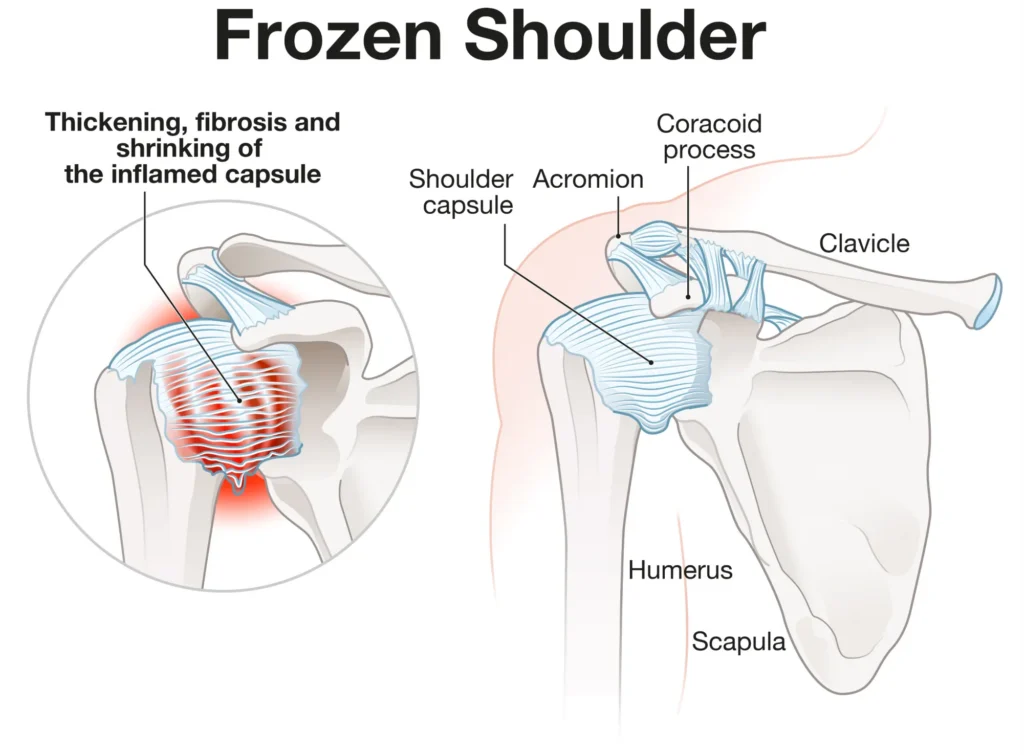
What causes frozen shoulder to begin in the first place falls into two broad categories that I discuss with almost every patient: primary, or idiopathic, frozen shoulder, and secondary frozen shoulder, which develops in connection with an identifiable trigger.
Primary, or Idiopathic, Frozen Shoulder
A large share of the frozen shoulder cases I see have no clear precipitating event. The patient did not injure the shoulder, did not have surgery, and cannot point to anything that changed before symptoms started. This is what I mean by idiopathic, and it tends to overlap heavily with the hormonal and metabolic factors described below. In these cases, the underlying trigger appears to be something happening at a tissue level, likely inflammatory, rather than a mechanical injury the patient can identify.
Secondary Frozen Shoulder
Secondary frozen shoulder develops in the setting of another event or condition affecting the shoulder, most commonly prolonged immobility after an injury, a fracture, or surgery. When the shoulder is kept still for an extended stretch of time, the capsule is deprived of the regular motion that normally keeps it supple, and it can begin to tighten as a direct consequence. This is one of the more preventable pathways, which is part of why early, gentle motion after shoulder injuries and procedures gets so much emphasis in physical therapy.
The Hormone and Metabolic Connection
Frozen shoulder occurs at meaningfully higher rates in people with certain hormonal and metabolic conditions, and the relationship appears to run deeper than simple correlation. When I explain this connection during a visit, I usually watch a patient’s expression shift, because very few people walk into an orthopedic appointment expecting a conversation about their thyroid or their blood sugar.
Diabetes
Individuals with diabetes, particularly when blood sugar has been poorly controlled over time, develop frozen shoulder at a higher rate than the general population, and their cases may be more resistant to treatment. One possible explanation that is discussed in the orthopedic literature involves the effect of elevated blood sugar on collagen, the structural protein that makes up much of the joint capsule. Persistently high glucose levels may alter collagen in ways that make it stiffer and more prone to the kind of thickening seen in frozen shoulder.
Thyroid Disorders
Both an underactive thyroid and an overactive thyroid have been linked to a higher likelihood of developing frozen shoulder. The thyroid gland influences metabolism throughout the body, including in connective tissue, and disruptions to that balance may affect how the shoulder capsule responds to routine inflammation.
Other Contributing Factors
Certain cardiovascular conditions, some autoimmune conditions, and Parkinson’s disease have also been associated with frozen shoulder in the medical literature, though the relationships in these areas are less well defined than the diabetes and thyroid connections. Age and sex play a role too. Frozen shoulder is most common between ages 40 and 60, and it develops more often in women than in men, for reasons that are not fully understood. Hormonal shifts around perimenopause and menopause have been proposed as a partial explanation for the difference in how often women develop this condition compared to men, though this remains an area of ongoing study.
Why Some Patients Develop It Twice
One question I get often, especially from patients with a hormonal or metabolic contributor, is whether frozen shoulder can come back or affect the other side. It can, though developing it in both shoulders at the same time is relatively uncommon. Usually, if it does affect both sides, one shoulder develops symptoms first and the other follows at some point later.
Recurrence in the same shoulder after a full recovery is less common, but it is not impossible, particularly if the underlying contributor, such as poorly controlled blood sugar, has not changed.
Injury, Surgery, and Immobility as a Trigger
Beyond the hormonal picture, I regularly see frozen shoulder develop after a rotator cuff injury, a fracture, or surgery of any kind, including procedures unrelated to the shoulder that still require the arm to be kept still for a period, such as a mastectomy or certain cardiac procedures. The common thread is a stretch of reduced motion, sometimes just a few weeks, that gives the capsule an opportunity to tighten. This is one reason I place so much emphasis on early, protected motion whenever it is safe to do so after an injury or procedure.
What I See in My Patients Here in Denver
A pattern I notice often in my Denver practice involves patients who spent a winter season limiting shoulder use after a minor injury, sometimes something as simple as a fall on the ice, without realizing that the prolonged rest itself was setting up a second problem.
I also see a fair number of patients who mention, almost as an afterthought, that they have hypothyroidism or type 2 diabetes, not realizing there could be any connection to their shoulder at all. I think that disconnect is worth addressing directly with every frozen shoulder patient, because understanding the likely cause changes how urgently I recommend certain interventions and how I set expectations for the timeline of recovery.
How Understanding the Cause Shapes My Approach
I do not treat every frozen shoulder identically, because the underlying cause genuinely affects the plan. For a patient with secondary frozen shoulder tied to a recent surgery, my focus is on restoring motion as early and safely as the healing tissue allows. For a patient with an idiopathic or hormonally linked case, I tend to have a more direct conversation early on about the likelihood that this will be a longer process.
A detailed breakdown of those treatment options, including physical therapy, injections, hydrodilatation, manipulation under anesthesia, and arthroscopic capsular release, is something I cover thoroughly in my dedicated post on frozen shoulder treatment options.
Can Frozen Shoulder Be Prevented?
Prevention depends heavily on which pathway is most relevant to you. For secondary frozen shoulder tied to immobility, the most effective prevention tool is early, appropriate motion after an injury or surgery, guided by a physical therapist or your surgeon rather than attempted on your own.
For patients whose risk comes primarily from diabetes or thyroid disease, prevention is less straightforward, since frozen shoulder can develop even with reasonably well-managed conditions. That said, working with your primary care physician or endocrinologist to keep blood sugar and thyroid function within a healthy range is a sensible step that supports your whole body, shoulder included.
Summary
What causes frozen shoulder is rarely a single answer. Some cases begin with no identifiable trigger and appear connected to hormonal or metabolic factors like diabetes and thyroid disease. Others follow a period of shoulder immobility after an injury or surgery. Knowing which pathway applies to your case does not just satisfy curiosity. It changes how I counsel you on timeline and how proactively I recommend we intervene.
If you are in the Denver area and dealing with shoulder stiffness that has been building for weeks or months without an obvious cause, I would encourage you to come in so we can look at the full picture together, including whether an underlying metabolic factor might be involved. You can request an appointment online or call our office at (303) 436-4949 to get started.
Frequently Asked Questions
Can frozen shoulder happen without any injury at all?
Yes, and this is actually one of the more common patterns I see. Idiopathic frozen shoulder develops with no identifiable triggering event, though it may be connected to hormonal or metabolic factors.
If I have diabetes, will I definitely develop frozen shoulder?
No. Diabetes increases the likelihood of developing frozen shoulder, particularly when blood sugar has been difficult to control, but it does not guarantee it will happen. Many people with diabetes never develop the condition, and good long-term blood sugar management may help reduce that risk.
Does frozen shoulder run in families?
There is not strong evidence of a direct hereditary pattern for frozen shoulder in the way some orthopedic conditions run in families. That said, conditions that increase risk, such as diabetes and thyroid disorders, can have familial patterns, which may partly explain why some patients notice frozen shoulder appearing among relatives. I would not consider family history alone a reason for concern, but it is a detail worth mentioning during your evaluation.