



Medically reviewed by Jessica Churchill, MD | Reviewed July 2026
Nerve pain in the elbow, and knowing when to see a doctor about it, is a conversation I have with patients almost every week in my Denver clinic. Most people know the jolt of hitting the funny bone, that quick electric zing that fades in a few seconds. What I am describing here is something different, like a lingering tingling, numbness, or ache that sticks around.
In my practice, patients often wait far longer than they should before mentioning this symptom, usually because it comes and goes, or because they assume it is simply how a joint feels with age. I understand the instinct to brush it off. But nerve symptoms in the elbow behave differently than muscle or joint pain, and knowing when to let it ride out on its own versus when to come in for an exam can make a difference in how well the nerve recovers.
Key Takeaways
- Most nerve pain in the elbow comes from irritation or compression of the ulnar nerve as it passes through a narrow passage called the cubital tunnel.
- Typical symptoms include tingling or numbness in the ring and small fingers, especially when the elbow stays bent for long periods.
- Early cases often improve with activity changes, nighttime splinting, and specific nerve gliding exercises.
- Ignoring ongoing numbness or hand weakness allows nerve compression to progress, sometimes to the point of permanent muscle changes in the hand.
What Causes Nerve Pain at the Elbow
Most nerve pain in the elbow traces back to one structure. The ulnar nerve travels down the inside of the arm and passes through a tight passage on the inner elbow called the cubital tunnel, formed by bone, ligament, and muscle. Because this tunnel narrows further when the elbow bends, prolonged flexion, resting an elbow on a desk or armrest, or sleeping with the arm curled against the chest can all compress the nerve over time.
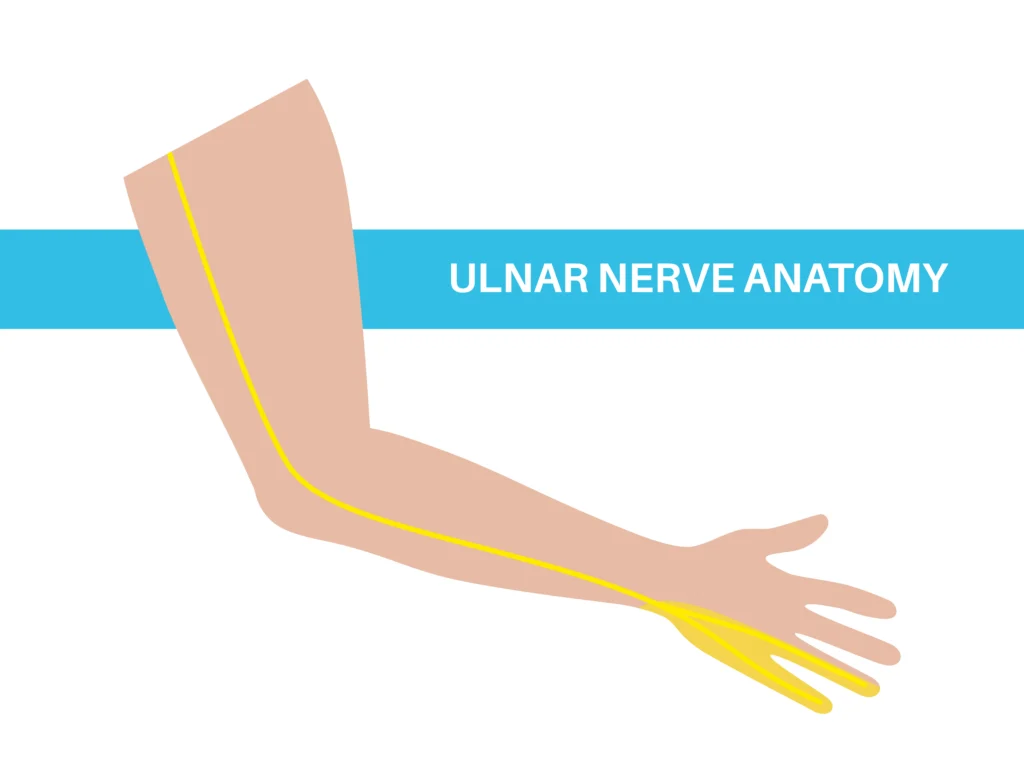
Some people develop symptoms from a single direct blow to the inner elbow. Others develop them gradually, from years of repetitive bending during work or hobbies that keep the arm in a flexed position for extended stretches.
Recognizing the Symptoms
A common symptom is tingling or numbness that concentrates in the ring and small fingers rather than the whole hand, a pattern that distinguishes ulnar nerve involvement from carpal tunnel syndrome, which affects the thumb, index, and middle fingers instead. Many patients first notice this at night, waking with a numb or tingling hand after sleeping with the elbow bent.
As irritation progresses, some people notice hand weakness, clumsiness with fine tasks like buttoning a shirt, or a visible loss of muscle bulk between the fingers in more advanced cases.
Severity tends to fall along a spectrum rather than a simple present-or-absent scale. Mild cases might involve occasional tingling after an hour of reading with a bent elbow, symptoms that resolve within minutes of straightening the arm. Moderate cases may bring numbness that lingers for longer stretches and starts interrupting sleep on a regular basis.
Advanced cases can progress to constant numbness, noticeable grip weakness, and in the most significant cases, visible thinning of the small muscles between the fingers, a sign that the nerve has been under pressure long enough to affect the muscle it supplies. Recognizing where symptoms fall on this spectrum shapes how quickly I think treatment should escalate.
Other Possible Causes of Nerve Pain in the Elbow
Not every ache on the inner elbow points to the ulnar nerve. Tennis elbow, technically called lateral epicondylitis, involves the tendons on the outer elbow rather than a nerve, and golfer’s elbow affects the inner tendons without necessarily compressing the nerve itself. Arthritis, bone spurs, and prior fractures around the elbow can also narrow the cubital tunnel and contribute to nerve symptoms, which is one reason imaging sometimes plays a role even when the diagnosis seems straightforward from the history alone. Occasionally, nerve symptoms that seem to originate at the elbow actually trace back to compression higher up, in the neck or shoulder, which is why a thorough exam looks beyond the elbow itself.
What I See in My Patients
Denver’s Cycling and Desk Culture
Denver’s cycling culture sends me a steady stream of ulnar nerve complaints, particularly from riders who spend long stretches on mountain descents gripping drop handlebars with the elbow bent and weight pressing into the palm. I also see this in people who work from home and spend entire video calls leaning on a bent elbow against a desk, a habit most patients do not even realize they have formed until I ask them to picture their typical workday.
Tradespeople who work with the elbow flexed for hours, whether running cable, operating machinery, or doing detailed assembly work, make up another large share of the patients I see for this condition.
The Sleep Position Nobody Notices
One pattern I bring up often in clinic is sleep position. A remarkable number of patients sleep with the affected elbow tucked tightly against the chest or under a pillow, holding it in deep flexion for hours every night without realizing it. Something as simple as a soft splint that keeps the elbow straighter overnight resolves a meaningful share of milder cases before we ever discuss anything more involved.
Winter Sports and Hobbies
Skiers and snowboarders bring their own version of this problem during the winter months, often from falls directly onto a flexed elbow or from gripping poles in a bent position for hours on the mountain. I also see a fair number of guitar and piano players, whose instrument technique keeps the fretting or fingering arm bent for long practice sessions, and older patients whose elbow arthritis has narrowed the cubital tunnel gradually over years without a single memorable moment when symptoms began.
My Approach to Treatment
Exam and Testing
My evaluation starts with a history focused on hand position during work, sleep, and hobbies, followed by an exam that tests sensation in each finger individually and checks hand strength for early signs of nerve-related weakness. When the diagnosis is not entirely clear, or when symptoms are more advanced, I may order a nerve conduction study to measure how well electrical signals travel along the ulnar nerve. It can also help pinpoint exactly where the compression is occurring.
Starting Nonsurgical
For most patients caught early, I generally start with nonsurgical care, including a nighttime extension splint to prevent prolonged elbow bending during sleep, activity modifications during the day, and nerve gliding exercises that help the nerve move more freely through the tunnel. This approach resolves symptoms for a large share of patients without ever requiring surgery.
When symptoms persist despite several months of conservative care, or when there is measurable weakness or muscle wasting in the hand, I discuss surgical decompression, a procedure aimed at relieving pressure on the nerve and giving it room to recover. I tend to recommend moving toward surgery sooner rather than later once weakness enters the picture, since nerves that stay compressed for a long stretch do not always regain full function even after the pressure is relieved.
These principles guide how I manage the broader range of elbow disorders I treat throughout my Denver practice, where nerve, tendon, and joint problems all show up with their own distinct patterns.
Why Timing Affects Recovery
Recovery after surgical decompression varies depending on how long the nerve was compressed before treatment. Patients treated early, before significant weakness sets in, often notice tingling improve within weeks and regain full sensation over the following months.
Patients who wait until muscle wasting has developed may see meaningful improvement in pain and tingling, but full strength does not always return, since damaged nerve tissue and muscle do not always recover completely once the loss has set in. This is the piece of the conversation I wish more patients heard before symptoms progressed that far, because the difference between treating this early and treating it late is often the difference between a full recovery and a partial one.
Summary
Tingling that fades in a few seconds is nothing to worry about. If you are still wondering when nerve pain in the elbow means it is time to see a doctor, numbness that lingers well after you change position is your answer, and it is worth a real conversation rather than another few months of waiting it out. Schedule a visit with my office, particularly if you have noticed any new weakness in your hand, so we can catch nerve irritation while it is still easy to treat.
Frequently Asked Questions
Is numbness in my ring and pinky finger always related to my elbow?
Often yes, since this pattern is characteristic of ulnar nerve involvement at the elbow, though nerve compression higher up in the neck can occasionally cause similar symptoms.
Can I keep exercising if I have cubital tunnel symptoms?
Most activities can continue with some modification, though movements that require prolonged elbow bending or direct pressure on the inner elbow may need to be adjusted temporarily.
Do I need surgery for ulnar nerve compression?
Not necessarily, many cases improve with splinting, activity changes, and nerve gliding exercises, and surgery is generally reserved for cases that do not improve or that involve weakness.
How is nerve compression at the elbow different from carpal tunnel syndrome?
Cubital tunnel syndrome affects the ring and small fingers through compression at the elbow, while carpal tunnel syndrome affects the thumb, index, and middle fingers through compression at the wrist.