



Medically reviewed by Jessica Churchill, MD | Reviewed June 2026
In my practice, I see cubital tunnel syndrome fairly often. It tends to start as a distracting tingling in the ring and small fingers. The symptoms can come and go, and the elbow does not always hurt in an obvious way. But when I examine these patients and confirm compression of the ulnar nerve, I want them to know two things: this is a real condition with a clear anatomical cause, and there are options for relief. Dismissing it or waiting too long can sometimes allow it to progress in ways that are harder to reverse.
Key Takeaways
- Cubital tunnel syndrome develops when the ulnar nerve becomes compressed at the inner elbow, often from prolonged bending or direct pressure on the joint.
- The most recognizable symptoms are tingling and numbness in the ring and small fingers, particularly when the elbow is held in a flexed position for a long time.
- Many patients respond well to non-surgical treatment, including splinting, activity modification, and nerve gliding exercises.
- When symptoms persist or muscle weakness develops, surgical decompression may be considered to protect the nerve from lasting damage.
What Is Cubital Tunnel Syndrome?
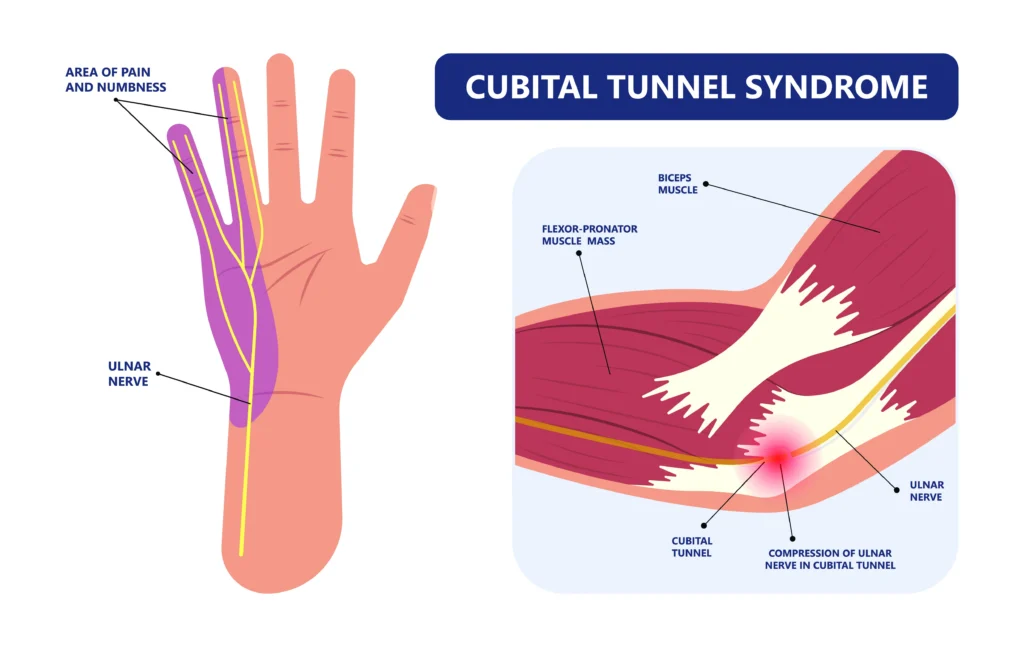
Cubital tunnel syndrome is a nerve compression condition affecting the ulnar nerve at the elbow. The ulnar nerve travels from the neck down through the arm and passes through a narrow channel on the inner side of the elbow called the cubital tunnel. This channel is formed by bone, muscle, and connective tissue. When the nerve gets compressed or stretched in that space, it can trigger pain, numbness, and tingling along the inner forearm and into the hand.
The ulnar nerve is the one responsible for that jolt you feel when you bump your “funny bone.” That sensation is actually the nerve being irritated, and in cubital tunnel syndrome, that irritation becomes chronic. The nerve sits close to the surface at the elbow, which makes it vulnerable. Bending the elbow tightens the tunnel and can put meaningful pressure on the nerve over time.
This condition is the second most common nerve compression problem in the arm, after carpal tunnel syndrome, which involves a different nerve at the wrist. Cubital tunnel syndrome has its own distinct pattern of symptoms, and the two are sometimes confused.
Causes and Risk Factors
Prolonged elbow flexion is one of the most common contributors. People who talk on the phone with their arm bent for long stretches, sleep with their elbow curled under them, or keep their arms flexed at a desk for hours tend to show up in my clinic with these symptoms. The position itself is not unusual. Most of us bend our elbows constantly during the day. The problem is sustained compression combined with limited relief.
Direct pressure on the inner elbow can also play a role. Leaning on a hard surface with the arm, such as resting the elbow on a car door or armrest for extended periods, may irritate the nerve. In some cases, previous elbow injuries, bone spurs, or joint changes from arthritis can narrow the cubital tunnel and crowd the nerve. People who perform repetitive overhead tasks or throwing motions can also be at elevated risk.
I want to be honest with patients: sometimes there is no single identifiable cause. The nerve can become sensitized gradually, especially in people whose anatomy places the nerve in a slightly more vulnerable position to begin with.
What I See in My Denver Patients
Denver is an active city. I treat runners, cyclists, climbers, desk workers, construction crews, nurses, musicians. What I notice is that cubital tunnel syndrome does not discriminate by lifestyle. I see it in people who are very physically active and in people whose work keeps them seated for most of the day.
The symptom that tends to bring patients in is the nighttime tingling. People will wake up and find that their ring finger and small finger have gone numb, often because they bent their arm while sleeping. Some describe it as the whole hand feeling asleep but concentrated in those two fingers.
What I find clinically is that many patients have had symptoms for longer than they realize. They adapted. They switched the phone to the other hand, stopped certain exercises, stopped sleeping on that side. By the time they come in, some have developed noticeable grip weakness or difficulty with tasks like buttoning a shirt or picking up small objects. Those are the cases I want to see earlier, because they suggest the nerve has been under stress for a while.
How Cubital Tunnel Syndrome Is Diagnosed
Diagnosis begins with a conversation. I ask about which fingers are involved, how long symptoms have been present, what positions or activities make things worse, and whether the symptoms are constant or intermittent. The pattern of involvement in the ring and small fingers, rather than the thumb and first two fingers, is a distinguishing feature that points toward ulnar nerve compression rather than carpal tunnel syndrome.
A physical examination follows. I check sensation in the affected fingers, test grip and pinch strength, and assess how the nerve responds to specific positions. There is a clinical test called the elbow flexion test, where holding the elbow in a fully bent position for about a minute can reproduce tingling in cubital tunnel syndrome. I also assess for signs at the elbow itself.
Imaging may be useful in some cases. X-rays can reveal bone spurs or joint changes that may be contributing to nerve compression. If the picture is unclear or I need to assess the nerve more precisely, nerve conduction studies can measure how well the ulnar nerve is transmitting signals. A slowed signal at the elbow is consistent with cubital tunnel syndrome and can help confirm the diagnosis and gauge severity.
My Approach to Treatment
My starting point is almost always conservative management, unless the examination shows significant weakness or loss of muscle bulk in the hand, which suggests the nerve has been compressed long enough to begin affecting the muscles it supplies. In those cases, I have a more direct conversation about intervention.
For patients without weakness, I typically begin with a nighttime splint to keep the elbow from bending past a comfortable range during sleep. This alone can make a noticeable difference. I also review how patients use their arm during the day. Workstation adjustments, avoiding hard elbow resting surfaces, and changing habitual postures can take meaningful pressure off the nerve.
Nerve gliding exercises may help the nerve move more freely through the cubital tunnel rather than getting stuck in one position under tension. These are simple movements I walk patients through, and they can be done at home.
When conservative measures do not produce sufficient improvement after a consistent trial, or when strength is compromised, I discuss surgical options with my patients. The goal of surgery is to decompress the ulnar nerve and, in some cases, reposition it so it is no longer vulnerable to the same mechanical stress. The specific approach depends on the individual patient.
One thing I am clear about with patients: surgery for cubital tunnel syndrome is not a quick fix with instant results. Nerve recovery takes time. Patients frequently notice gradual improvement in sensation over weeks to months after decompression. How much function returns can depend on how long the nerve was compressed and how severe the changes were before surgery.
When to Seek Evaluation
If you have noticed persistent tingling or numbness in your ring and small fingers, especially with elbow flexion, that is worth a conversation with an elbow specialist. Symptoms that return regularly, last longer, or are accompanied by any weakness in the hand are more significant.
I also want to say plainly: do not wait until you lose grip strength. That level of change means the nerve compression has been going on long enough to affect muscle function, and those changes are harder to reverse than sensory symptoms. Coming in earlier gives us more options and generally leads to a better outcome.
Summary
Cubital tunnel syndrome is a nerve compression condition that responds well to early, thoughtful care. Most patients I see with this diagnosis do not need surgery, particularly when we catch it before weakness sets in. The key is not ignoring the symptoms. Tingling in the small and ring fingers, nighttime numbness, and sensitivity along the inner elbow are all signals worth paying attention to. If those patterns sound familiar, I encourage you to get evaluated. A clear diagnosis and a structured plan make a real difference in how this condition resolves. You can learn more about the common elbow conditions I treat or reach out to schedule a consultation at my Denver Health office.
Frequently Asked Questions
What does cubital tunnel syndrome feel like?
The most characteristic sensation is tingling and numbness in the ring finger and small finger, often described as the hand feeling asleep in those two digits. Some patients also notice an aching sensation along the inner elbow. Symptoms may worsen when the elbow is bent for a prolonged period, such as during a long phone call or while sleeping.
Is cubital tunnel syndrome the same as carpal tunnel syndrome?
No. Both involve nerve compression in the arm, but they affect different nerves. Carpal tunnel syndrome compresses the median nerve at the wrist and typically causes symptoms in the thumb, index, and middle fingers. Cubital tunnel syndrome compresses the ulnar nerve at the elbow and causes symptoms in the ring and small fingers. The distinction matters for diagnosis and treatment.
How long does recovery take after cubital tunnel surgery?
Nerve recovery is gradual. Sensory symptoms such as tingling often begin to improve within a few months of surgical decompression, though the full extent of recovery can take longer. Muscle weakness, if present before surgery, may take additional time to resolve, and in some cases permanent changes can occur if compression was prolonged. Your individual timeline depends on how long the nerve was affected before treatment.