



Medically reviewed by Jessica Churchill, MD | Reviewed July 2026
“Why can’t I lift my arm above my head?” is a question I hear almost every week in my Denver clinic. Reaching for a mug on the top shelf. Pulling a shirt over your head. Twisting an arm back to grab a seatbelt. These are motions most people do without a second thought, until the day the arm simply will not go up the way it used to.
In my practice, this is one of the most common complaints I hear from patients, and it rarely comes from a single cause. Some people notice pain only partway through the motion. Others feel a deep ache that lingers after the arm comes back down, or a weakness that makes lifting anything overhead feel unreliable.
Key Takeaways
- Trouble lifting the arm overhead is often tied to the rotator cuff, the space beneath the shoulder blade, or the joint capsule, and each structure points toward a different treatment path.
- Most causes of overhead shoulder pain respond well to physical therapy and activity changes before surgery ever becomes part of the conversation.
- A confident diagnosis typically requires a hands-on exam, and sometimes imaging, rather than a guess based on symptoms alone.
Why Overhead Motion Hurts
Subacromial Impingement
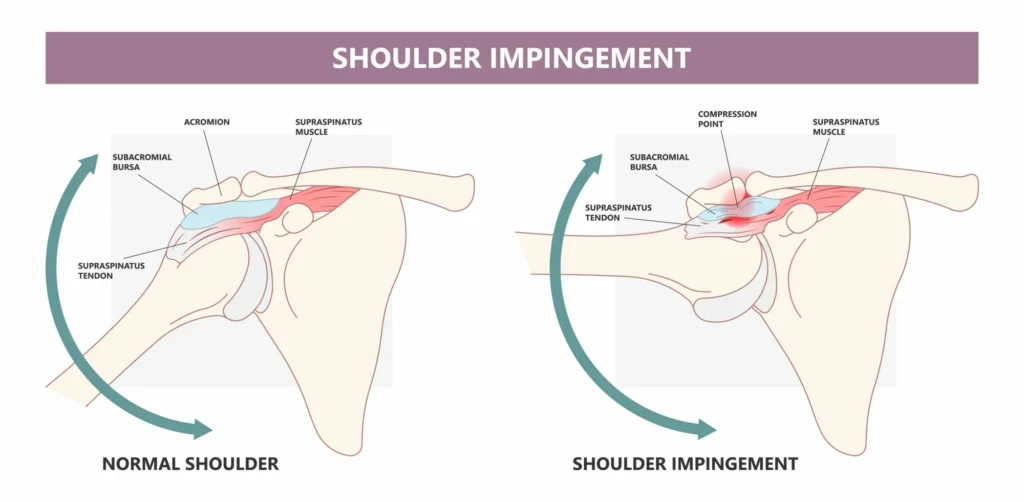
The shoulder relies on a tight partnership between bones, tendons, and a thin lubricating space called the subacromial space, which sits just beneath the tip of the shoulder blade. When the arm lifts overhead, the rotator cuff tendons glide through this space.
If the space narrows, from swelling, a bone spur, or years of repetitive overhead work, those tendons can become pinched. This is called subacromial impingement, and it tends to produce pain concentrated in a specific arc of motion rather than throughout the entire lift. Patients often describe it as a pinch or catch that eases once the arm clears a certain height.
Rotator Cuff Tears
A rotator cuff tear is a different problem, though it can start from the same irritation. Repeated impingement, a fall, or a sudden pulling motion can tear one of the four rotator cuff tendons, partially or completely. Unlike impingement alone, a tear often causes weakness that persists even after the joint calms down, along with pain that disrupts sleep.
Small partial tears may respond to the same conservative measures used for impingement. Larger or full-thickness tears may need a more structured conversation about repair, particularly in patients who rely on shoulder strength for work or sport.
Frozen Shoulder
Frozen shoulder, known clinically as adhesive capsulitis, works through an entirely different mechanism. The capsule surrounding the joint thickens and tightens, restricting motion in nearly every direction, not just overhead reaching. It tends to develop gradually, often over weeks, and is more common in people managing diabetes or thyroid conditions. In my experience, patients who describe stiffness reaching behind the back or across the body, in addition to overhead limitations, are more likely dealing with a capsule problem than a tendon problem.
Labral Tears
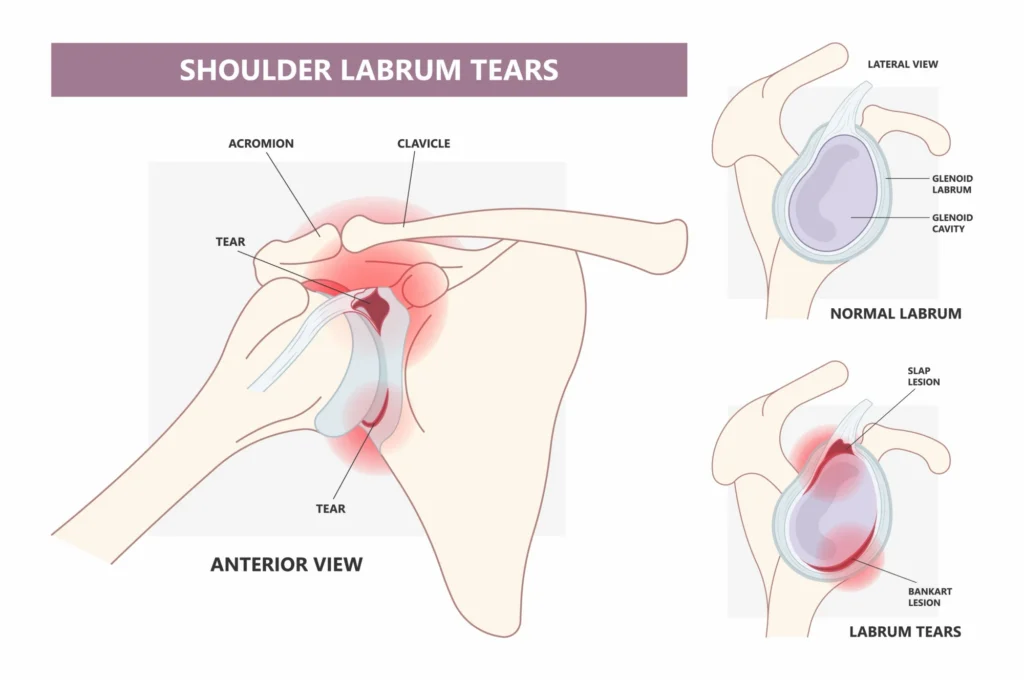
Labral tears round out the list, though they are somewhat less common as a cause of isolated overhead pain. The labrum is a ring of cartilage that deepens the shoulder socket, and a tear here, often from a fall onto an outstretched arm or years of overhead throwing, can cause a catching or locking sensation along with the pain. It can overlap with impingement symptoms enough that imaging becomes useful for sorting the two apart.
Getting an Accurate Diagnosis
None of these conditions are diagnosed from symptoms alone. A physical exam typically includes a series of specific arm positions designed to reproduce the pain and isolate which structure is responsible, along with strength testing for each of the rotator cuff muscles individually.
When the picture is unclear, or when a tear seems likely based on the exam, an MRI gives a much clearer view of the tendons, labrum, and joint capsule than an X-ray alone. X-rays still play a role, particularly for ruling out arthritis or bone spurs that may be narrowing the subacromial space in the first place.
What I See in My Patients
Denver’s Overhead Lifestyle
When a patient asks me why they can’t lift their arm above their head, the answer almost always starts with their daily routine rather than a single injury. Denver gives people plenty of reasons to reach overhead. I see recreational climbers who spend weekends at nearby crags, cyclists loading gear onto roof racks before a mountain trip, and gardeners who spend a Saturday reaching into raised beds only to wake up unable to lift a coffee cup the next morning.
I also see a steady stream of people whose jobs quietly wear down the shoulder over years, warehouse workers reaching to top shelves, dental hygienists holding their arms in fixed positions all day, and remote workers whose posture has drifted forward after years at a home desk. It is rarely one dramatic injury. More often, it is a slow accumulation of small stresses that finally catches up with the joint.
Why the Pattern of Pain Matters
What surprises many patients is how much the pattern of pain matters. Someone who tells me the pain only bothers them midway through raising the arm, then eases near the top, is describing something very different from someone whose arm feels weak the entire time.
My Approach to Treatment
Starting With a Careful Exam
My evaluation always starts with a conversation and a hands-on exam. I want to know when the pain started, what makes it worse, and whether there was a specific injury or a slow build. From there, I typically test the shoulder through a range of positions to see exactly where symptoms appear, which helps me distinguish impingement, a tear, and capsule tightness from one another without jumping straight to imaging.
Starting Conservative
For most patients without significant trauma or major weakness, I generally recommend a structured course of physical therapy and medications to reduce inflammation. Therapy aimed at the rotator cuff and the muscles that stabilize the shoulder blade resolves a large share of overhead pain.
When Surgery Enters the Conversation
When conservative care does not restore function, or when imaging confirms a larger rotator cuff tear or unstable labral injury, I discuss surgical repair as one option among several. These decisions depend heavily on activity level, occupation, and the specific structures involved, and I find that patients make better choices when they understand exactly which part of the shoulder is causing the problem rather than treating shoulder pain as one broad category. Many of the conditions I see in this category, including impingement, rotator cuff injury, and frozen shoulder, fall within the range of shoulder disorders I treat regularly in my Denver practice.
What Recovery Looks Like
Recovery expectations differ quite a bit depending on the diagnosis. A course of physical therapy for impingement may resolve symptoms within a matter of weeks. Frozen shoulder, on the other hand, tends to run a longer course regardless of treatment, sometimes stretching over several months as the capsule gradually loosens. Rotator cuff repair carries its own timeline, generally built around protecting the repair early on before layering in strength work later. I would rather set realistic expectations up front than have a patient feel discouraged three weeks into a process that was always going to take longer.
Summary
Overhead motion should not be something you brace for every time you reach for a shelf. If you are still asking yourself why you can’t lift your arm above your head after weeks of hoping it would settle on its own, do not wait through more months of guessing. Schedule an evaluation with my office, and we can work through whether this is irritation that will settle with the right exercises, or something structural that deserves a closer look before it gets harder to treat.
Frequently Asked Questions
Is it normal for my arm to feel weak when I lift it overhead?
Some weakness with overhead lifting is common with irritation or inflammation, but weakness that persists after rest can point to a rotator cuff tear and generally deserves an evaluation.
How long should I try physical therapy before considering imaging?
Most patients try a structured course of therapy for several weeks before imaging enters the conversation, though significant weakness or a clear traumatic injury may move that timeline up.
Can poor posture from desk work really affect shoulder motion?
Yes, prolonged forward posture can change how the shoulder blade moves and narrow the space available for the rotator cuff tendons, which may contribute to impingement over time.
Does difficulty lifting my arm always mean a torn rotator cuff?
No, impingement, frozen shoulder, and labral tears can all limit overhead motion, and the specific pattern of symptoms usually helps sort out which structure is involved.
When does shoulder pain warrant a sooner appointment rather than a wait-and-see approach?
Sudden weakness, pain following a fall or forceful injury, or inability to lift the arm at all are reasons to schedule sooner rather than waiting to see if symptoms improve on their own.