

If you’ve recently taken a fall onto your shoulder or experienced a direct impact during a sport or accident, you may be dealing with an AC joint separation. It is one of the more common shoulder injuries seen in orthopedic practice, and many patients improve with appropriate care and guidance. Whether you’re an athlete, someone who leads an active lifestyle, or simply had an unexpected tumble, this post breaks down what you need to know about AC joint separation.
Key Takeaways
- The AC joint connects your collarbone to the top of your shoulder blade, and an AC joint separation occurs when the ligaments holding that joint together are stretched or torn.
- These injuries are classified by grade, from Grade I (mild sprain) to Grade VI (severe displacement), and treatment depends heavily on that grade.
- Many separations respond well to non-surgical treatment including rest, ice, physical therapy, and pain management.
- Severe separations may require surgical reconstruction to restore proper joint alignment and stability.
What Is the AC Joint?
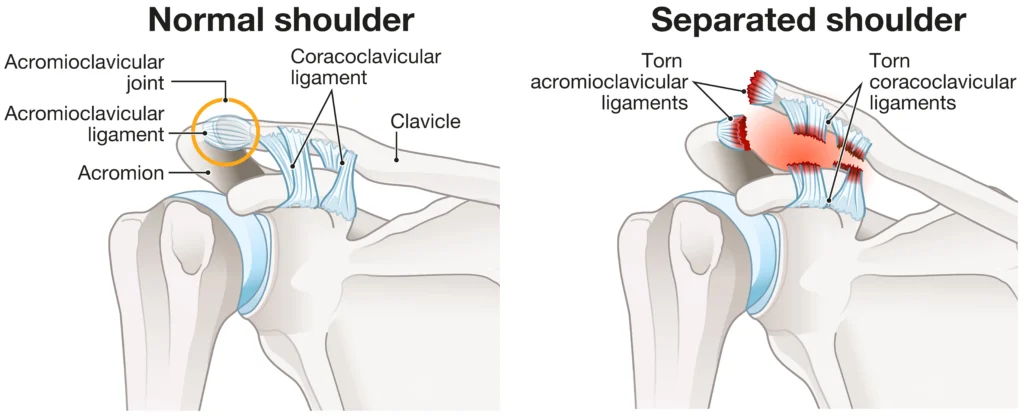
The acromioclavicular (AC) joint sits at the very top of your shoulder. It’s the point where your collarbone, also called the clavicle, meets the acromion, which is the bony tip of your shoulder blade (scapula). You can actually feel it yourself: run your fingers along your collarbone toward your shoulder, and you’ll find that small bony bump right at the top. That’s the AC joint.
This joint plays an important role in shoulder function. It helps stabilize your shoulder and plays a role in allowing your arm to lift and move freely overhead. Several strong ligaments hold the joint together, specifically the acromioclavicular ligament and the coracoclavicular ligaments. These structures keep the collarbone and shoulder blade properly aligned with each other. When those ligaments are overstretched or torn, the joint may lose its normal alignment. That shift in alignment is what defines an AC joint separation, and it can range from a minor stretch to a significant structural disruption depending on how much force was involved.
What Causes AC Joint Separation?
AC joint separation typically results from trauma to the shoulder. The most common cause is a direct fall onto the tip of the shoulder. Think landing hard during a cycling accident, a football tackle, a ski crash, or a simple slip on ice. That sudden impact can place significant force on the AC joint and may result in ligament injury.
Other common causes include:
- A direct blow to the shoulder, such as from a collision in contact sports
- Falling onto an outstretched hand, which transfers force up through the arm into the shoulder
- Motor vehicle accidents involving a shoulder impact
- Workplace injuries from falls from height or sudden impacts
Athletes in contact and collision sports, including cyclists, football and hockey players, and rugby players, tend to face a higher risk due to the physical demands of their sport. That said, AC joint separation isn’t exclusive to athletes.
Understanding the Grades of AC Joint Separation
Not all AC joint separations are the same, and the grade of your injury plays a big role in determining what happens next. Orthopedic surgeons commonly classify these injuries into grades based on which ligaments were damaged and how far the joint has shifted out of alignment.
Grade I is the mildest form. The acromioclavicular ligament is sprained but not fully torn, and the joint stays in its proper position. Most patients with Grade I injuries heal well with conservative care and a relatively short recovery period.
Grade II involves a torn acromioclavicular ligament, while the coracoclavicular ligaments remain mostly intact. There’s partial displacement of the joint, and a small bump may start to develop at the top of the shoulder.
Grade III is where things get more complex. Both sets of ligaments are torn, and the collarbone shifts noticeably upward out of its normal position. Some Grade III injuries may be treated non-surgically, though the appropriate approach depends on factors such as activity level, occupation, and patient goals.
Grades IV, V, and VI involve more severe displacement. The collarbone may be pushed backward into the trapezius muscle, significantly elevated, or, in rare cases, displaced in an unusual direction. These higher-grade injuries are less common but far more likely to require surgical repair to restore proper shoulder mechanics.
Signs and Symptoms to Watch For
Pain at the top of the shoulder is typically the most recognizable sign of an AC joint separation. The area is often tender to the touch, and you may notice swelling or bruising in the hours following the injury. In more significant separations, a visible bump can develop where the collarbone has shifted upward. In some patients, that bump may remain visible even after symptoms improve.
Other symptoms commonly associated with this injury include:
- Pain that worsens when you lift your arm, especially overhead
- Difficulty sleeping on the affected side
- Weakness or noticeably limited range of motion in the shoulder
- Achiness when reaching across your body
- A sense of shoulder instability or discomfort with movement
The severity of symptoms tends to reflect the grade of the injury. A Grade I sprain may cause localized tenderness and mild swelling, while a Grade V separation can significantly limit how much you’re able to use your arm. It’s also worth knowing that symptoms from an AC joint separation can sometimes overlap with other shoulder conditions, which is one of many reasons a proper evaluation from an experienced shoulder specialist matters.
How Is AC Joint Separation Diagnosed?
If your shoulder has taken a significant impact and you’re experiencing pain at the top of the joint, it’s worth getting it evaluated. Your doctor may begin with a detailed physical examination, assessing tenderness at the AC joint, evaluating your range of motion, and checking for any visible deformity or signs of instability.
Imaging usually plays a role in confirming the diagnosis and grading the injury. X-rays are typically the first step, and they can often show clearly how much displacement has occurred. If there’s concern about additional damage to nearby soft tissues, such as a rotator cuff injury occurring alongside the AC joint separation, an MRI may sometimes be ordered to evaluate surrounding soft tissues.
Non-Surgical Treatment Options
Many AC joint separations respond well to non-surgical management. Rest and activity modification build a foundation of early care. Avoiding overhead lifting and high-impact activities gives the ligaments space to recover. A sling may be recommended to help offload the joint and reduce discomfort. Ice and anti-inflammatory medications may be recommended to help manage pain and swelling, especially in the early phase. In some cases, a corticosteroid injection may be considered to help reduce inflammation and allow a patient to participate more comfortably in rehabilitation.
Physical therapy is often a key component of recovery. A skilled therapist will work with you to restore range of motion, rebuild shoulder strength, and retrain movement patterns that reduce stress on the healing AC joint. The goal isn’t just getting you out of pain; it’s also about restoring real, functional movement so you can return to the activities that matter most.
When Surgery May Be Recommended
For higher-grade injuries, surgical reconstruction may be the recommended direction. In these cases, the degree of displacement is significant enough that conservative care alone is unlikely to restore proper shoulder mechanics.
Surgical techniques for AC joint reconstruction aim to restore alignment between the collarbone and shoulder blade and improve joint stability. The specific approach depends on factors like the grade of the injury, how much time has passed since it occurred, and what you need your shoulder to do in daily life or sport. Recovery after surgery involves a period of shoulder protection, followed by a progressive physical therapy program to restore motion, strength, and function.
Recovery and Rehabilitation
Recovery from an AC joint separation looks different for every person. Mild injuries managed without surgery often start showing meaningful improvement within a few weeks. More severe separations may involve a recovery timeline spanning several months or longer.
Regardless of whether surgery is involved, rehabilitation tends to follow a predictable progression. Early goals center on managing pain and swelling and protecting the healing structures. As things settle down, attention shifts to restoring mobility. The final phase focuses on rebuilding strength and gradually preparing patients to return to normal activities when appropriate.
One thing worth saying clearly: patience matters. Returning to activity too soon can stress healing ligaments and extend your overall recovery beyond what would have happened with a more measured approach.
Summary
AC joint separation is a common but sometimes complex shoulder injury. It spans a wide spectrum, from mild ligament sprains that heal well with rest and physical therapy to significant structural disruptions that call for surgical repair. Where you fall on that spectrum, combined with your personal goals and activity demands, shapes the treatment approach that makes the most sense for you.
Frequently Asked Questions
Can an AC joint separation heal without surgery?
Yes, in many cases it can. Grade I and Grade II separations, along with a meaningful portion of Grade III injuries, may heal well with conservative treatment, including rest, a sling, physical therapy, and anti-inflammatory medication. Higher-grade injuries are generally less likely to resolve without surgical intervention.
Will that bump on my shoulder go away?
The visible bump at the top of the shoulder, caused by the displaced collarbone, may persist even after pain resolves and function is restored. For many patients, this cosmetic change doesn’t affect how the shoulder works day to day. Whether it’s bothersome enough to consider surgery is a personal decision worth discussing with your surgeon.
Is it safe to exercise with an AC joint separation?
It depends on the severity of your injury and where you are in the recovery process. During the early phase, overhead lifting and high-impact activities are generally off the table to protect the healing structures. As recovery progresses, a physical therapist will guide you through a graduated return to exercise that minimizes re-injury risk. Always follow your care team’s specific recommendations rather than pushing through pain on your own.